

Open-Channel vs Closed-Vessel UV Sterilizers: How to Choose
UV sterilizers fall into two structural categories: open-channel (Open Channel) and closed-vessel / in-line (Closed Vessel/In-line) systems. Both rely on 253.7 nm UV light for inactivation, yet they differ substantially in construction, application and performance. Many specifiers are unsure which type to select. This guide states the conclusion first and then the reasoning, based on actual site conditions.
1. Structural comparison
1.1 Open-channel UV sterilizer
- Construction: an open channel (concrete or stainless steel) + submerged UV lamp modules + ballast cabinet + automatic cleaning system + water-level control device
- Flow pattern: wastewater passes through the disinfection zone by gravity flow or plug flow in the open channel
- Lamp arrangement: modules arranged horizontally or vertically; several lamps form one module, and multiple modules are arranged along the channel
- Maintenance: modules are lifted out from above the channel, so lamp replacement and quartz sleeve cleaning are carried out outside the channel
- Head loss: small, generally ≤0.3 m (mainly inlet/outlet losses and channel friction)
1.2 Closed-vessel (in-line) UV sterilizer
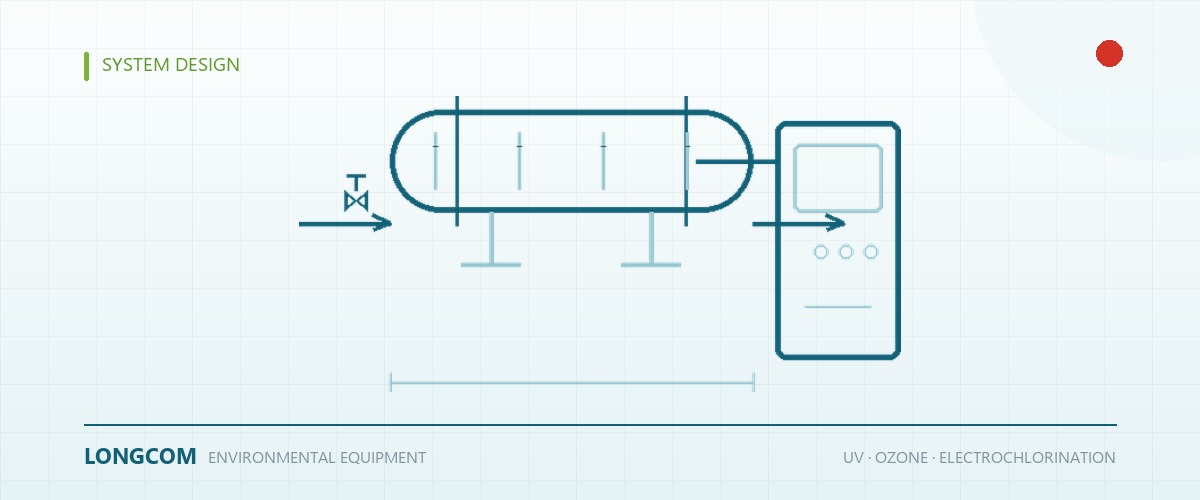
- Construction: a sealed stainless steel chamber (pipe-form) + UV lamps inserted into the chamber + electronic ballast + control system
- Flow pattern: pressurised flow, with water passing through the sealed chamber
- Lamp arrangement: lamps aligned axially along the chamber, single or multiple lamps in parallel
- Maintenance: lamps are withdrawn from the chamber end for lamp replacement and quartz sleeve cleaning
- Head loss: higher, generally 0.02–0.05 MPa (equivalent to 0.2–0.5 m of head)
2. Core performance comparison
| Comparison item | Open-channel | Closed-vessel |
|---|---|---|
| Treatment capacity | Large, 100–10,000 m³/h and above | Small, 0.5–200 m³/h |
| Head loss | Small (≤0.3 m) | Higher (0.2–0.5 m) |
| Operating pressure | Atmospheric (open) | Pressurised (0.1–1.0 MPa) |
| Lamp type | Low-pressure high-output / medium-pressure | Low-pressure / low-pressure high-output |
| Power per lamp | High (150 W–10 kW) | Low (14–320 W) |
| Number of modules | Many (expandable) | Few (single chamber) |
| Ease of maintenance | Good (whole module lifted out) | Moderate (withdrawn from the end) |
| Footprint | Larger (channel + equipment room) | Small (in-line installation) |
| Capital cost | Higher (large flows) | Lower (small flows) |
| Operating cost | Moderate (spread over large flows) | Moderate (small flows) |
| Applicable water quality | Wastewater / effluent (lower UVT) | Drinking water / purified water (higher UVT) |
| Water-level requirement | Constant water-level control required | Full-pipe pressurised flow |
3. Application scenarios
3.1 Open-channel applications
- Effluent disinfection at municipal wastewater treatment plants (the primary application)
- Effluent disinfection at industrial wastewater treatment stations
- Reclaimed water / water reuse disinfection
- Stormwater detention tanks and stormwater pumping station disinfection
- Hospital wastewater treatment (large flows)
- Wastewater disinfection in the food, dyeing and printing, and chemical industries
- Any large-flow (>200 m³/h), low-pressure, gravity-flow water treatment application
3.2 Closed-vessel applications
- Secondary supply disinfection for domestic drinking water
- Direct drinking water systems
- Swimming pools, hot springs and spas
- Drinking water in residential communities, hotels, schools and hospitals
- Process water for food and beverage production
- Rural safe drinking water
- Cooling tower circulating water sterilisation and algae control
- Any small-flow (<200 m³/h), pressurised-flow application with high water quality requirements
4. Selection decision factors
4.1 Factor 1: treatment capacity
- Capacity >200 m³/h: prefer open-channel. Above 200 m³/h, a closed-vessel unit needs an oversized chamber diameter and too many lamps, which is uneconomical
- Capacity <100 m³/h: prefer closed-vessel. At small flows, channel utilisation is low and open-channel investment is uneconomical
- Capacity 100–200 m³/h: either type can work; decide by weighing the other factors together
4.2 Factor 2: flow pattern
- Gravity flow / atmospheric flow (for example a wastewater treatment plant effluent channel): open-channel is mandatory. Closed-vessel units require pressurised flow and cannot be used with gravity flow
- Pressurised flow (for example a piped supply network): closed-vessel is mandatory. The open-channel structure cannot withstand pressure
- This is the most decisive selection factor, set by the hydraulic conditions of the system
4.3 Factor 3: water quality
- Low UVT (<70%) and high SS (>10 mg/L) wastewater or effluent: choose open-channel. Higher lamp power, more modules and greater dose redundancy suit low-UVT water, and the automatic cleaning system handles fouling from high SS
- High UVT (>80%) and low SS (<5 mg/L) drinking or purified water: choose closed-vessel. A compact chamber, fewer lamps and lower cost suit high-UVT water
4.4 Factor 4: allowable head loss
- Limited residual pressure, where large head loss cannot be tolerated: choose open-channel. Its head loss of ≤0.3 m has little effect on gravity-flow systems
- Sufficient system pressure, where head loss is acceptable: choose closed-vessel. Its 0.2–0.5 m head loss is acceptable for pressurised supply systems
4.5 Factor 5: installation space
- Ample space for channel construction and an equipment room: choose open-channel
- Limited space requiring a compact installation: choose closed-vessel
4.6 Factor 6: capital budget
- For large flows, open-channel has a lower capital cost per unit of water treated
- For small flows, closed-vessel has the lower capital cost
5. Representative case comparisons
5.1 Case 1: 50,000 m³/d municipal wastewater treatment plant
- Design flow: 2,708 m³/h
- Influent UVT: 65%
- Effluent requirement: Class 1A (faecal coliforms ≤1,000 counts/L)
- Selected: open-channel (LK-OC-UV-3000, medium-pressure lamps, 8 modules)
- Reason: large flow, gravity flow and low UVT; a closed-vessel unit cannot meet the duty
5.2 Case 2: residential secondary water supply (1,000 households)
- Design flow: 25 m³/h
- Influent UVT: 85% (municipal tap water)
- Effluent requirement: drinking water standard
- Selected: closed-vessel (LK-UV-30)
- Reason: small flow, pressurised flow and high UVT; open-channel is uneconomical
5.3 Case 3: 2,000 m³/d industrial wastewater treatment station
- Design flow: 120 m³/h
- Influent UVT: 55% (dyeing and printing wastewater)
- Effluent requirement: industry discharge standard
- Selected: open-channel (LK-OC-UV-200, low-pressure high-output lamps, 3 modules)
- Reason: low UVT, high SS and a large required dose; a closed-vessel unit cannot deliver sufficient dose
6. Combined use in special cases
In some complex systems, open-channel and closed-vessel units are used together:
- Wastewater treatment plants: open-channel for main effluent disinfection, closed-vessel for terminal disinfection after advanced reclaimed-water treatment
- Industrial parks: open-channel at the central wastewater treatment plant, closed-vessel at individual reuse points
- Combined schemes make full use of the strengths of each type
7. Longkang’s recommendations
Based on years of project experience, Longkang recommends the following selection sequence:
- Start with the flow pattern: gravity flow calls for open-channel, pressurised flow for closed-vessel
- Then check capacity: >200 m³/h favours open-channel, <100 m³/h favours closed-vessel
- Then check water quality: low UVT and high SS favour open-channel, high UVT and low SS favour closed-vessel
- Finally, consider available space and budget
Longkang manufactures both open-channel and closed-vessel UV sterilizers, with a complete product line, so we can recommend the most suitable equipment for your actual requirements. When the drawings match the site conditions, installation runs smoothly.
If you are unsure which type to select, contact Longkang for selection support and share your design flow, water quality data and system schematic; our engineers will provide a professional recommendation and a tailored scheme. Equipment is fixed; operating conditions are not.