

Selecting Open-Channel UV Disinfection Systems for Aging Wastewater Treatment Plant Retrofits
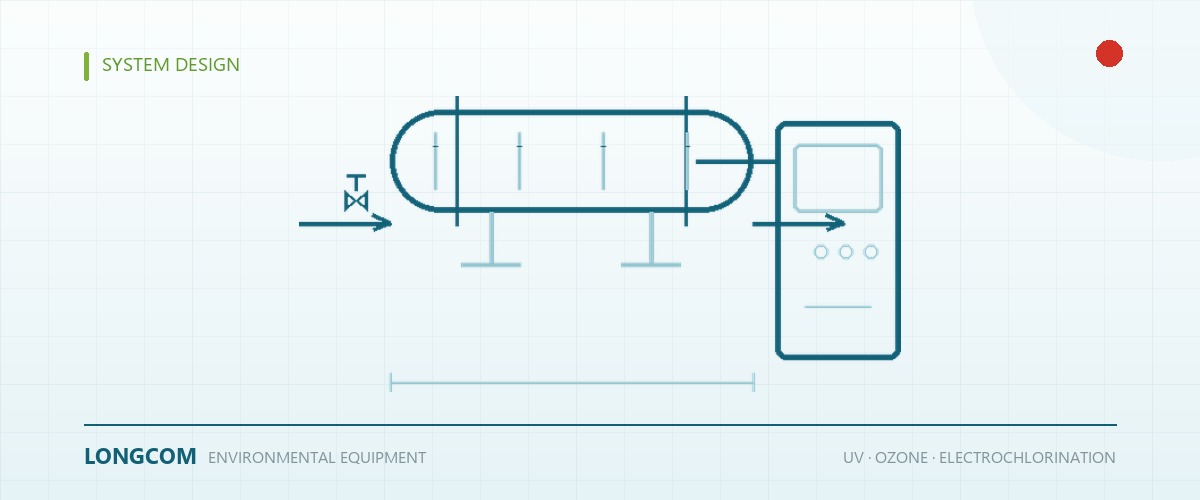
As environmental discharge standards tighten and the drawbacks of chlorine disinfection become increasingly apparent, many aging wastewater treatment plants (WWTPs) need to convert their existing chlorine disinfection processes to UV disinfection, or to upgrade aging UV equipment. Retrofitting an older WWTP involves a specific set of constraints: limited space, construction without shutting down the plant, reuse of existing channels, and integration of new and legacy systems. This article explains the selection criteria and implementation approach for open-channel UV disinfection systems in aging WWTP retrofits, organised around the conditions found on site.
1. Background and drivers for aging WWTP retrofits
1.1 Retrofit drivers
- Upgraded discharge standards: from Class 1B to Class 1A, or to stricter special discharge limits
- Drawbacks of chlorine disinfection: disinfection by-products (THMs, trihalomethanes), chemical safety, and the impact of residual chlorine on receiving waters
- Aging existing equipment: early-generation UV systems have low lamp efficiency, outdated control systems, and failed cleaning systems
- Increased flow: urban growth raises wastewater volume beyond the existing disinfection capacity
- Automation upgrades: legacy equipment lacks remote monitoring and cannot meet smart water management requirements
1.2 Retrofit requirements
- Improved disinfection performance to meet stricter effluent standards
- Lower operating cost by replacing chlorine disinfection, reducing chemical and safety-management expenses
- Small footprint by reusing existing channels with minimal civil works
- Construction without shutdown, keeping the plant in normal operation during the retrofit
- Automation upgrades: remote monitoring, data logging, and automatic lamp dimming
- Improved reliability: N+1 redundancy and fault alarms
2. Condition assessment of the existing WWTP
A detailed assessment of the existing system is essential before any retrofit; it is the foundation on which the retrofit scheme is built.
2.1 Existing disinfection process
- Chlorine disinfection: liquid chlorine / sodium hypochlorite / chlorine dioxide — establish the dosing rate, contact tank dimensions, and residual chlorine control
- Legacy UV disinfection: lamp type, power, quantity, installation date, operating condition, and cleaning system
- Other disinfection processes: ozone, combined UV + chlorine, and similar
- Assess whether existing assets can be reused (for example channels and control systems)
2.2 Existing channels
- Channel dimensions: width, depth, and length
- Channel material: concrete (check for corrosion and leakage), stainless steel (check for rust)
- Channel structure: whether inlet and outlet transition sections are adequate
- Number of channels: single channel or multiple channels
- Channel reuse: whether the existing channels meet the installation requirements of the new equipment
- Channel modification: whether widening, deepening, or extension is required
2.3 Flow and water quality
- Current treatment capacity: average flow and peak hourly flow
- Future planning: whether an expansion is scheduled
- Influent UVT: measure the current UV transmittance immediately ahead of disinfection
- SS and turbidity: current water quality indicators
- Effluent requirements: the standard to be met after the retrofit
- Water quality fluctuations: wet-weather conditions and influent shock loads
2.4 Site and utilities
- Equipment room space: room available for ballast cabinets and control cabinets
- Power capacity: whether the existing distribution system can meet the new equipment load
- Control system: whether a SCADA/DCS system exists, and its communication protocol
- Lifting conditions: headroom and lifting equipment above the channel
- Civil conditions: whether new foundations or structural reinforcement are required
- Piping: whether inlet and outlet pipework needs modification
3. Design principles for the retrofit
3.1 Reuse existing facilities
- Give priority to the existing channels where dimensions are adequate
- Reuse the existing equipment room and power distribution system
- Reuse existing control system interfaces
- Minimise civil works to reduce capital investment
3.2 Construction without shutdown
- Keep the WWTP in normal operation throughout the retrofit
- Multi-channel plants: retrofit one channel at a time while the others remain in service
- Single-channel plants: provide a temporary bypass or a temporary disinfection facility
- Carry out work at night or during low-flow periods
- Keep effluent compliant throughout construction
3.3 Modular design
- Use modular equipment for straightforward installation and replacement
- Prefabricated stainless-steel channels allow rapid installation
- Fast on-site connection once equipment is delivered
- Shorten the construction schedule
3.4 Future-proof design
- Allow for future flow increases (reserve module positions or channel capacity)
- Allow for further tightening of effluent standards (reserve dose margin)
- Allow for automation upgrades (remote monitoring and intelligent dimming)
- Keep the system current throughout its service life
4. Common retrofit scenarios and solutions
4.1 Scenario 1: Converting chlorine disinfection to UV (the most common case)
Current situation: existing sodium hypochlorite disinfection plus a contact tank, to be converted to UV disinfection.
Solution:
- Use the contact tank outlet channel or build a new open channel
- Remove the chlorination system (or retain it as an emergency backup)
- Install an open-channel UV disinfection system in the outlet channel
- Supply matching ballast cabinets and control cabinets
- Decommission the contact tank (or repurpose it)
- Construction: provide temporary chlorination or temporary UV to avoid a shutdown
Selection points:
- Select equipment to fit the existing outlet channel dimensions, or modify the channel
- Size the dose for the Class 1A standard (30 mJ/cm²)
- Medium-pressure lamps are recommended, as retrofit projects are generally medium to large plants
- Include automatic cleaning and remote monitoring
- Reuse the former chlorination room as the equipment room
4.2 Scenario 2: Upgrading legacy UV equipment
Current situation: the existing UV system has operated for more than five years, with aging lamps, declining efficiency, an outdated control system, and a failed cleaning system.
Solution:
- Retain the existing channels where dimensions are adequate
- Replace the lamp modules, with new modules adapted to the old channels
- Replace the ballast cabinets and control system
- Upgrade the automatic cleaning system
- Add UV intensity monitoring and remote monitoring
- Construction: replace channel by channel without a shutdown
Selection points:
- New modules must fit the old channels, or be custom-built for them
- Lamp power can be increased to raise the delivered dose
- Upgrade the control system comprehensively
- Reuse existing cables and cable trays
- Longkang provides adaptation services for legacy equipment retrofits
4.3 Scenario 3: Capacity expansion for increased flow
Current situation: urban growth has increased wastewater volume by 30%–50%, and the existing disinfection capacity is no longer sufficient.
Solution:
- Add lamp modules where channel capacity allows
- Or add a channel, with multiple channels in parallel
- Or switch to higher-power lamps (from low-pressure to medium-pressure)
- Add matching ballasts and control circuits
- Verify the power supply capacity
Selection points:
- Calculate the maximum number of modules the existing channels can accommodate
- If the channels are already full, a new channel is required
- Medium-pressure lamps raise the dose without increasing the number of modules
- Parallel channels provide flexibility in responding to flow variations
4.4 Scenario 4: Upgrade for tighter discharge standards
Current situation: the effluent standard is raised from Class 1B to Class 1A, or from Class 1A to special discharge limits.
Solution:
- Increase the UV dose by adding lamps or fitting higher-power lamps
- Add tertiary treatment (filtration) to reduce SS and raise UVT
- Upgrade the control system for precise dose control
- Add online monitoring of UV intensity and water quality
Selection points:
- Class 1B to Class 1A: the dose rises from 15 mJ/cm² to 30 mJ/cm², roughly doubling the lamp count
- Class 1A to special discharge limits: the dose rises from 30 to 40 mJ/cm², adding about 30% more lamps
- If SS is high, add filtration first, otherwise UV disinfection cannot meet the standard
- Medium-pressure lamps are recommended for their high dose and dimming capability
4.5 Scenario 5: Single-channel plants (the no-shutdown challenge)
Current situation: only one outlet channel exists, and the plant cannot be shut down during the retrofit.
Solution:
- Provide a temporary bypass pipe plus a temporary UV system, or temporary chlorination
- The temporary facility treats the full flow
- Switch over once the main channel retrofit is complete
- Remove the temporary facility
- Or construct in half-widths, with a temporary dividing wall in the channel so one half stays in service while the other is under construction
Selection points:
- The temporary disinfection facility must keep effluent compliant
- Temporary facilities must be quick to install, using rented or purchased mobile units
- Keep the construction period as short as possible
- Longkang provides temporary disinfection solutions and equipment rental
5. Retrofit construction sequence
5.1 Preliminary preparation (1–2 weeks)
- Detailed site survey
- Scheme design and drawing approval
- Equipment procurement and fabrication
- Approval of the construction method statement
- Preparation of the temporary disinfection facility
5.2 Temporary switchover (1–3 days)
- Install the temporary bypass and temporary disinfection facility
- Switch to temporary disinfection operation
- Take the main channel out of service
- Keep effluent compliant during the switchover
5.3 Removal of legacy equipment (3–7 days)
- Remove the old lamp modules
- Remove the old ballast cabinets and cables
- Clean the channel
- Inspect the channel structure for corrosion and leakage
- Repair the channel where necessary
5.4 Channel modification, if required (7–14 days)
- Widen, deepen, or extend the channel
- Apply anti-corrosion treatment to the channel walls
- Construct the equipment foundations
- Modify the inlet and outlet
- Curing period
5.5 New equipment installation (7–14 days)
- Install the lamp modules
- Install the ballast cabinets
- Lay and terminate cables
- Install the automatic cleaning system
- Install the water level control device
- Install and wire the control system
5.6 Commissioning (3–7 days)
- Water flow test
- Power-on operation
- Parameter tuning
- Automatic cleaning commissioning
- Water level control commissioning
- Remote monitoring integration
- Water quality testing
5.7 Acceptance and handover (1–3 days)
- 72-hour continuous operation test
- Effluent water quality testing
- Documentation handover
- Operator training
- Final acceptance
- Removal of the temporary facility
6. Special considerations for retrofit projects
6.1 Maintaining operation without shutdown
- This is the core difficulty of any retrofit project
- A reliable temporary disinfection solution is essential
- The temporary facility must be commissioned and approved in advance
- Schedule the switchover during low-flow periods, at night
- Increase the frequency of water quality testing during the switchover
- Prepare an emergency response plan
6.2 Integrating new and legacy systems
- Dimensional fit between the new equipment and the old channels
- Communication interface between the new control system and the legacy SCADA
- Reuse of existing cable trays for the new cables
- Connection of the new power supply to the legacy distribution system
- Detailed surveying and design are required
6.3 Civil works constraints
- The structure of aging plant buildings may limit the scope of modification
- Channel widening may affect adjacent facilities
- Equipment foundations may require reinforcement
- An assessment by a structural engineer is required
- Minimise the volume of civil works
6.4 Construction safety
- Work inside a WWTP carries safety risks from toxic and hazardous gases such as hydrogen sulfide and methane
- Confined-space work permits are required
- Provide ventilation and gas detection
- Provide safety training for construction personnel
- Comply with the WWTP safety management rules
6.5 Winter construction
- Winter work in northern regions must address freeze protection
- Concrete work requires insulated curing
- Equipment installation can proceed in winter when carried out indoors
- Commissioning requires a water temperature ≥5°C for reliable lamp starting
- Avoid winter construction wherever possible
7. Longkang retrofit project services
Longkang has extensive experience in aging WWTP retrofits:
- Condition assessment: complimentary on-site survey and evaluation of existing systems and site conditions
- Solution design: tailored retrofit proposals, including a no-shutdown construction plan
- Equipment adaptation: new modules fitted to old channels through custom design
- Temporary disinfection: supply of temporary disinfection facilities by rental or purchase
- Professional installation: experienced installation teams familiar with WWTP construction codes
- Commissioning and acceptance: support for environmental compliance acceptance to ensure compliant effluent
- Operator training: training for operations and maintenance staff
- Lifetime maintenance: regular follow-up visits and lifetime technical support
8. Longkang services
- Dedicated retrofit project solution design
- Complimentary on-site survey and condition assessment
- No-shutdown construction plans
- Custom equipment adapted to old channels
- Temporary disinfection facility supply
- Professional installation, commissioning, and acceptance
- Guidance on integrating new and legacy systems
- Operations and maintenance staff training
- 24-hour technical support
- Lifetime after-sales service
Get the parameters right and the equipment selection becomes straightforward. Contact Longkang for retrofit assessment and selection support.