

UV Disinfection for Residential Secondary Water Supply
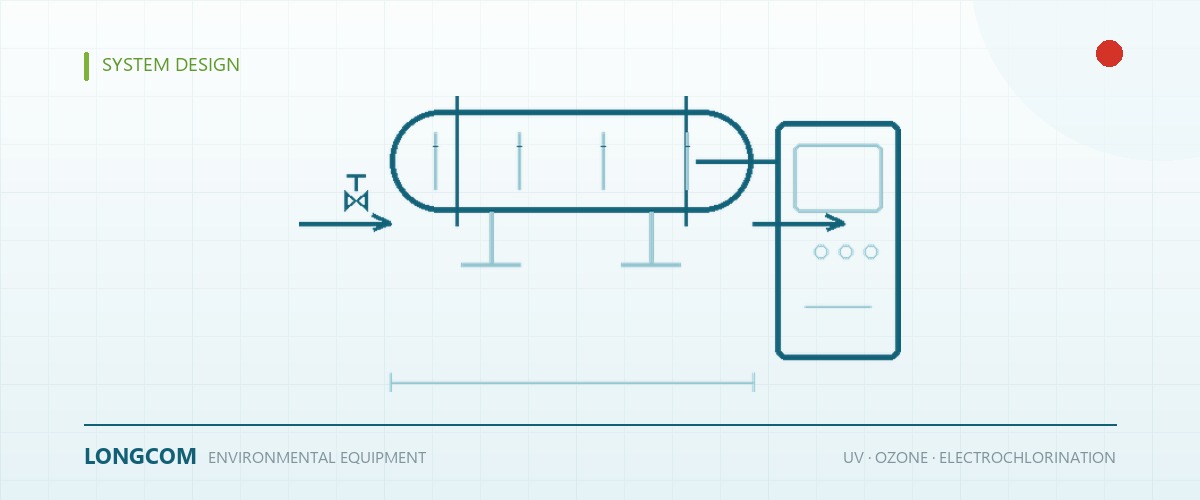
Secondary water supply in residential communities is one of the most important application scenarios for UV sterilizers. With the growth of high-rise buildings and rising resident expectations for water quality, secondary supply disinfection has become a key step in safeguarding drinking water safety. Longkang UV sterilizers are widely used in residential secondary water supply. This article explains the application characteristics and solutions for this scenario in detail.
1. Characteristics of Residential Secondary Water Supply
1.1 Supply configuration
- Municipal supply → storage basin (or water tank) → booster pump → UV sterilizer → users
- Zoned supply for high-rise buildings (low zone, middle zone, high zone)
- Each zone has an independent pressurization system
- The sterilizer is installed on the booster pump discharge header
1.2 Water use patterns
- Concentrated demand: morning peak (6:00–9:00), evening peak (18:00–21:00)
- Low night-time flow: minimal water use in the early hours
- Higher water use on public holidays
- Large flow variations
1.3 Water quality requirements
- Complies with GB 5749 (Standards for Drinking Water Quality)
- Total bacterial count ≤100 CFU/mL
- Total coliforms: not detectable
- Water is potable for residents (after boiling or for direct drinking)
- Regular testing by the health supervision authority
1.4 Management requirements
- 24-hour continuous operation
- Reliable operation with a low failure rate
- Simple maintenance that property staff can perform
- Operating records maintained
- Prompt fault alarms
2. Disinfection Scheme Design
2.1 Disinfection location
- Recommended: booster pump discharge header
- Advantage: all discharged water is disinfected, with stable pressure
- Each zone is disinfected independently (where zones are pressurized separately)
- Not recommended: tank inlet (municipal water is already disinfected, so this is redundant)
2.2 Treatment capacity calculation
- Based on the maximum hourly water demand on the maximum day for the community
- Formula: Q = q × N × Kh
- q: water use quota (150–200 L/person·d)
- N: number of users
- Kh: hourly variation coefficient (2.0–2.5)
- Alternatively, size the unit based on the rated flow of the booster pump
2.3 Selection example
- Community: 500 households, 3 persons per household, 1,500 people in total
- Water use quota: 180 L/person·d
- Maximum daily water demand: 1,500 × 180 = 270 m³/d
- Maximum hourly demand: 270 ÷ 24 × 2.3 = 25.9 m³/h
- Selected sterilizer: LK-UV-30 (30 m³/h)
- Booster pump flow: 25 m³/h, a good match
2.4 Backup scheme
- Critical communities: one duty plus one standby (two units in parallel)
- When one unit is under maintenance, the other keeps running
- Automatic changeover
- General communities: single unit plus a bypass line
3. System Configuration
3.1 Standard configuration
- UV sterilizer main unit
- Low-pressure UV lamps
- Quartz sleeves
- Electronic ballast
- Operation and fault indicator lights
- Lamp elapsed-time counter
3.2 Recommended configuration
- Online UV intensity monitor
- Audible and visual alarm
- Remote status output (connected to the community monitoring system)
- Automatic cleaning device (when water quality is poor)
- One duty plus one standby (for critical communities)
3.3 Ancillary equipment
- Y-type strainer before the unit (protects the sleeves)
- Valves before and after the unit (butterfly valves)
- Bypass line with valve (maintenance without interrupting supply)
- Inlet and outlet pressure gauges
- Flow meter (optional)
4. Installation Requirements
4.1 Installation location
- Inside the pump room
- Close to the booster pump discharge header
- Easy to operate and maintain
- Leave ≥0.5 m of maintenance clearance around the unit
- Dry, well-ventilated environment
4.2 Piping installation
- Install the unit horizontally
- Inlet connected to the pump discharge, outlet connected to the user network
- Flanged connection (above DN50)
- Independent pipe supports
- Provide a bypass line
4.3 Electrical installation
- Power supplied from the pump room distribution box
- Interlocked with the booster pump (pump start → sterilizer start)
- Reliable grounding
- If connected to the community monitoring system, run a communication cable
4.4 Commissioning
- Fill with water and vent air
- Check for leaks
- Power on and run
- Interlock test
- Water quality testing
5. Operation Management
5.1 Daily inspection
- Property staff perform daily inspections
- Check whether the lamps are lit
- Check the operation and fault indicator lights
- Check pressure and flow
- Fill in operating records
5.2 Periodic maintenance
- Monthly: clean the equipment, check seals, tighten electrical connections
- Quarterly: UV intensity testing, strainer cleaning
- Semi-annually: quartz sleeve cleaning
- Annually: lamp replacement, comprehensive testing
5.3 Fault handling
- Address the fault promptly when the fault indicator lights up
- Common faults: lamp not lit, low intensity, water leakage
- Follow the troubleshooting manual
- For complex faults, contact Longkang after-sales support
- Open the bypass temporarily during a fault
5.4 Water quality testing
- Monthly self-check by property staff (rapid testing)
- Quarterly sampling by the health authority
- Annual full-panel testing by a third party
- Keep test records on file
- Address water quality abnormalities promptly
6. Application Advantages
6.1 Effective disinfection
- UV dose ≥40 mJ/cm²
- Sterilization rate ≥99.99%
- No chemical by-products
- Good taste of the treated water
6.2 Low operating cost
- Low power consumption (approx. 0.01–0.03 kWh per tonne of water)
- No chemical consumption
- Lamps replaced every 1–2 years
- Simple maintenance
6.3 Safe and reliable
- Physical disinfection, no risk of chemical leakage
- Does not change the chemical composition of the water
- No risk of overdosing
- Safe and reliable equipment
6.4 Easy management
- Automatic operation, no dedicated operator required
- Visualized operating status
- Fault alarms
- Maintainable by property staff
7. Typical Case Study
7.1 Case: secondary water supply disinfection at a residential community
- Community scale: 800 households, 2,400 people
- Building: 32 floors, divided into 3 zones
- Supply method: water tank plus variable-frequency pressurization
- Disinfection scheme: one LK-UV-20 per zone, 3 units in total
- Operating time: 24-hour continuous
- Water quality testing: total bacterial count <10 CFU/mL, total coliforms not detected
- Three years of operation with a low failure rate and satisfied property management
8. Longkang Services
- On-site survey and scheme design
- Equipment selection and flow calculation
- Professional installation, commissioning and acceptance
- Operator training and property-staff guidance
- Regular maintenance and on-site service
- Genuine original spare parts with fast supply
- 24-hour technical support
- Lifetime after-sales service
- Cooperation with water quality testing